
To choose fresh broccoli, look for tight, compact florets in a deep green or slightly bluish-green color, with a firm, crisp stalk. Avoid heads with yellowing florets, soft spots, or a strong cabbage-like smell — these signal age. The cut end of the stalk should look fresh and moist, not dried out or brown.
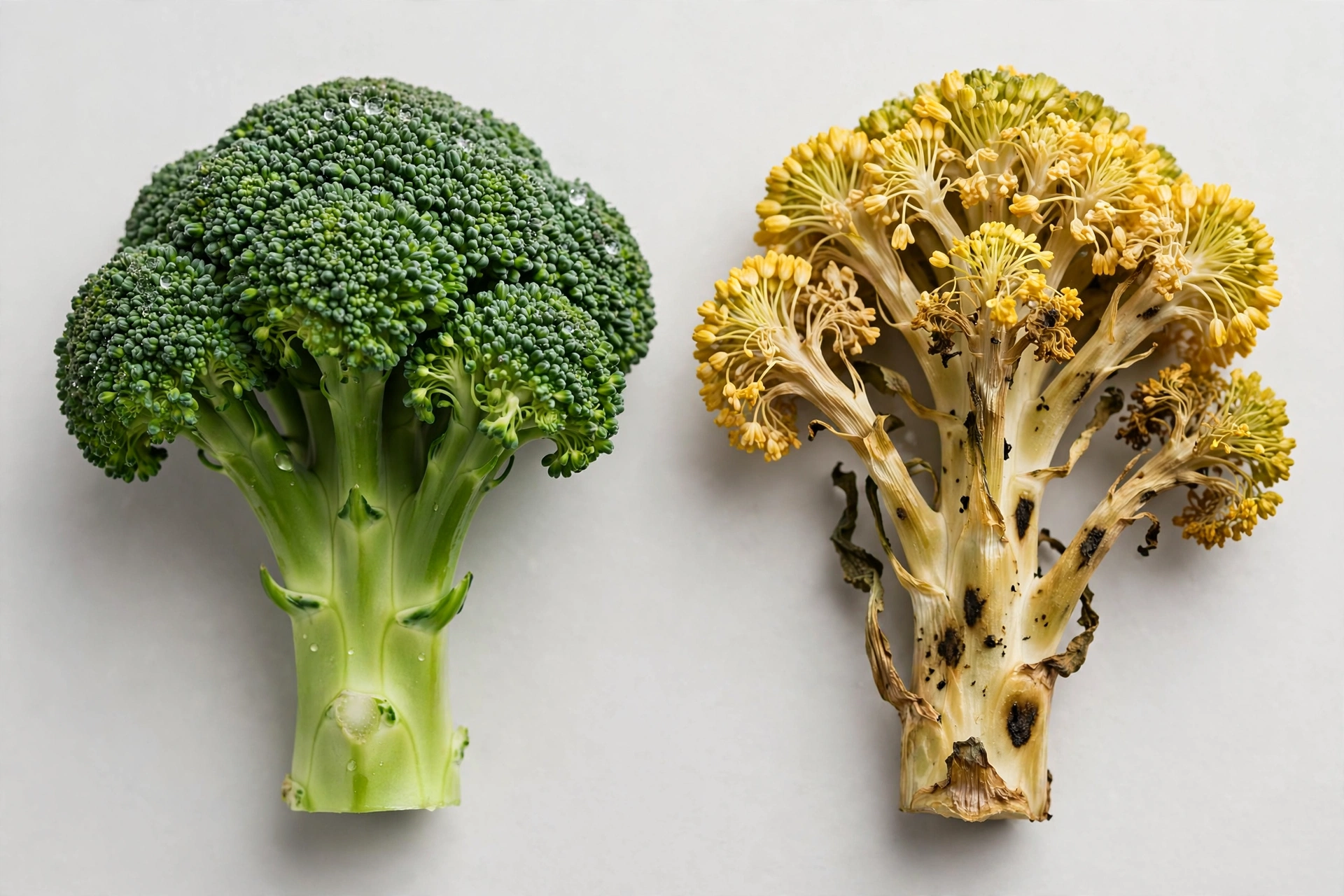
Prefer
- Tight, compact florets in deep green (a bluish or purplish tint is fine)
- Firm, crisp stalks that snap rather than bend
- A fresh, moist-looking cut end
- Crisp, green leaves if still attached
Avoid / check more closely
- Yellowing florets or open yellow flowers
- Soft, mushy, or slimy spots
- A strong, sulfurous smell
- Dried-out, brown, or cracked stalk ends
- Wilted, limp heads
Florets first: color and tightness
The florets are clusters of unopened flower buds, and their condition tells you the head’s age. Fresh broccoli has dense, tightly closed buds in a rich dark green — some varieties naturally carry a bluish or purplish cast, which is perfectly fine. As broccoli ages, the buds loosen, turn yellow, and eventually open into tiny yellow flowers. A few yellow flecks are just a cosmetic sign of age rather than a safety verdict, but widespread yellowing means the head is well past its prime in both texture and flavor. Squeeze the head gently: it should feel firm and compact, not soft or spongy.
Check the stalk and give it a sniff
The stalk is just as edible as the florets, so judge it too. A fresh stalk feels firm and crisp — it should snap cleanly when bent, not flex like rubber. Look at the cut end: a moist, pale-green cut suggests recent harvest, while a dried, brown, or hollow-looking end means it has been sitting around. Then smell the head. Fresh broccoli smells faintly green and clean; a strong sulfurous or cabbage-like odor means it is breaking down. Slimy patches anywhere on the head are a clear pass — rinsing cannot reliably fix those.
Storing broccoli at home
Keep broccoli unwashed in the refrigerator, loosely wrapped or in a perforated bag so some air circulates — sealed airtight bags trap moisture and speed up decay. It stays at its best for three to five days. Do not wash it until just before cooking. If the florets start to yellow slightly, the broccoli is still usable in cooked dishes where texture matters less, though very yellow or smelly heads should be discarded. Broccoli also freezes well after a brief blanching: blanch, chill in ice water, drain, and pack into freezer bags.
A simple broccoli-shopping checklist
Before you buy, check four things: florets (tight and dark green?), stalk (firm with a fresh cut?), smell (clean, not sulfurous?), and feel (crisp, not limp?). Choose heads sized for your plans, since cut broccoli deteriorates faster. These checks point you to the freshest heads, though storage conditions at home decide how long that freshness lasts.
Common questions
Is yellow broccoli safe to eat?
Slightly yellowed broccoli is generally a quality issue, not a safety alarm — it will taste more bitter and have a softer texture. If it also smells strongly sulfurous, feels slimy, or looks decayed, throw it out.
How should I store broccoli?
Unwashed, in the refrigerator, loosely wrapped or in a perforated bag for air circulation. Wash just before use. It keeps best for about three to five days.
Can you eat the stalk?
Yes — peel off the tough outer layer and the inner stalk is tender and sweet, great raw in salads or cooked alongside the florets. Do not throw away the most nutritious-bang-for-buck part.
References
U.S. Food and Drug Administration — Selecting and Serving Produce Safely. Reference for produce selection, handling, and visible damage. Storage guidance reflects standard kitchen practice.
Prepared October 9, 2026 with AI assistance. Cited sources do not endorse the entire article.