
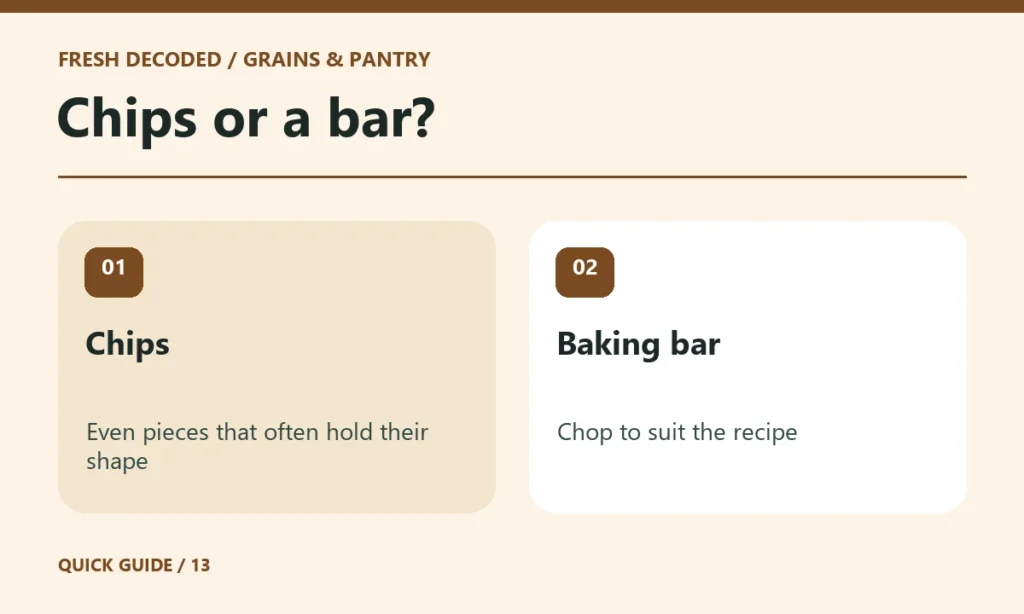
Choose chocolate by what the recipe asks it to do. Chips are convenient when you want regular pieces that stay distinct in a cookie. A bar lets you choose the size of the chopped pieces or measure chocolate for melting. The form and the sweetness are two separate choices.
For cookie pockets, size matters
Uniform chips distribute predictably. A chopped bar can create a mix of larger pools and small flecks. In King Arthur Baking's chocolate tests, chopped chocolate and chips behaved differently in cookies. A particular bag of chips can be made to hold its shape, but that is not a rule that all chips are impossible to melt.
If the recipe says “150 grams chopped semisweet chocolate,” using 150 grams of semisweet chips keeps the weight and broad flavor category similar, but the finished texture may differ. If you use chopped bar by the cup instead, the pieces can pack differently. Weigh the amount when the recipe supplies a weight.
For melting, check the kind of chocolate too
When a recipe names a bar or wafers for a coating, start with that format. Some chips can melt with gentle heating; King Arthur documents ways to melt both forms. A dark unsweetened baking bar is not an equivalent to sweetened semisweet chips merely because both melt. The sugar balance and flavor will change.
A shelf checklist
- Is the chocolate mixed in as pieces, melted into batter, or used as a coating?
- Does the recipe say unsweetened, semisweet, bittersweet, milk or another type?
- What weight do you need, and does the pack have enough?
- For a dietary or allergen question, read the actual ingredients and statements. Color and shape do not answer it.
For cocoa powder comparisons, use the linked guide. Cocoa powder is not a chopped chocolate bar in a different shape.