
Half-and-half and coffee creamer are not interchangeable product names. Compare the milk ingredients, added flavor or sweetener, serving measure and refrigeration instructions before choosing one for coffee or a recipe.
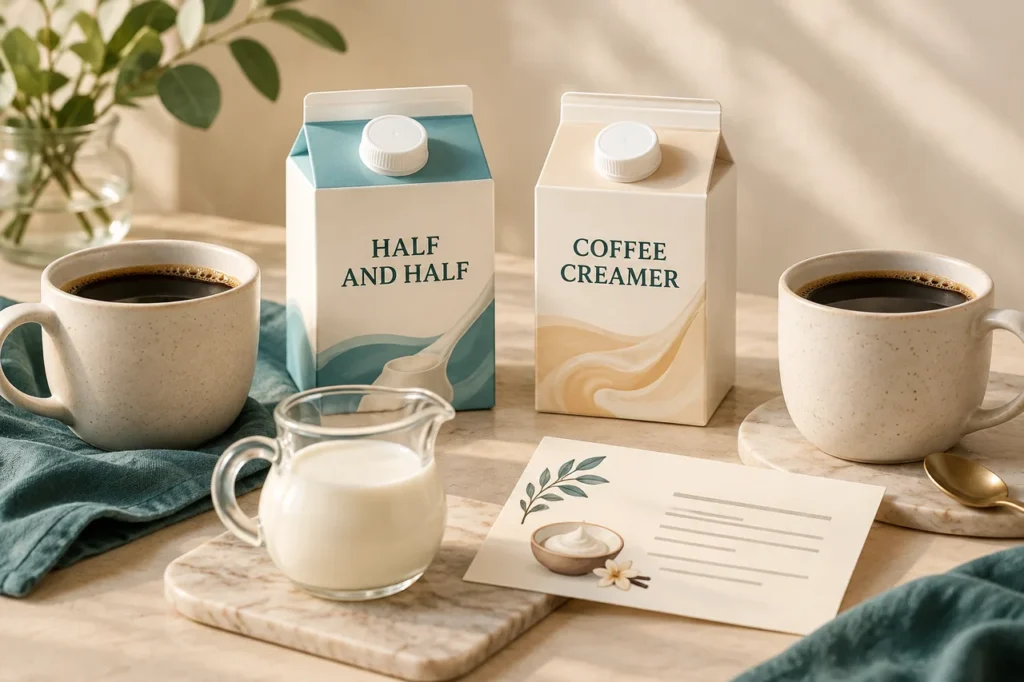
Illustrated packages and any label numbers are fictional teaching examples, not product specifications or evidence of safety. Follow the actual product instructions.
Useful checks
- Read the actual milk and cream ingredients
- Compare equal serving measures
- Check both unopened and opened storage instructions
Common mistakes
- Assuming all creamers are the same formula
- Putting sweet flavored creamer into a savory recipe by guesswork
Start with identity rather than a creamy photograph
In the United States, ordinary dairy half-and-half is a mixture of milk and cream. A coffee creamer can be a different formulation with its own ingredients and processing. Liquid and powdered formats also behave differently. Read the product description and ingredient list rather than assuming every pale liquid beside the coffee is a dairy product with the same composition. Standards and naming conventions vary outside the United States.
Do not translate a marketing word into an allergen answer
If avoiding a particular ingredient matters, read the complete label and any Contains statement. Do not treat a front-panel nondairy-style description as your only milk-allergen check. Conversely, do not assume a plant ingredient makes a product unsuitable for every recipe or automatically preferable. The useful question is whether the actual formula fits the person and purpose you are shopping for.
Compare the amount you actually pour
One product may list a tablespoon serving and another a smaller spoonful or a weight-based amount. Match the serving measures before comparing the printed sugar or fat numbers. A sweet flavored creamer also supplies flavor that plain half-and-half does not. Instead of declaring a winner from one line, compare the serving you intend to use and decide whether you want sweetness in the cup at all.
Choose by the job in a recipe
For coffee, portioning a small amount may be the main convenience. For a savory sauce calling for half-and-half, a sweet vanilla creamer is a substantial recipe change even if it looks equally creamy. Do not invent a direct substitution from color alone. Use the named ingredient or a tested substitution from the recipe developer. We have not tested brands for heat stability, frothing or taste.
Read the storage transition
A product sold on a shelf may still need refrigeration after opening, while another is refrigerated from the start. Individual sealed portions are not the same as an opened large bottle. Keep the use-after-opening directions and close the container after pouring. Choose a size you can use within those instructions. An aroma or smooth appearance does not prove that an incorrectly stored dairy or creamer product is safe.
Common questions
Is half-and-half whipping cream?
No. They are different product identities; do not expect the same whipping or recipe performance.
Does a shelf display mean no refrigeration is ever needed?
No. Read what changes after opening on that exact product.
References and scope
- Land O’Lakes: dairy ingredient descriptions — Manufacturer explanation of half-and-half as milk and cream. No brand test or endorsement is claimed.
- FDA: Food Allergies — Reference for reading ingredient and allergen statements instead of relying on general marketing descriptions.
Prepared October 24, 2026 with AI assistance. References support the stated guidance and do not endorse the entire article. Shopping examples are editorial examples, not product tests or medical advice.