
A Contains statement identifies declared major-allergen ingredients, while May Contain is advisory wording about possible cross-contact. Read the ingredient list as well. Neither the absence of a separate Contains box nor an absent advisory statement is an all-clear certificate.
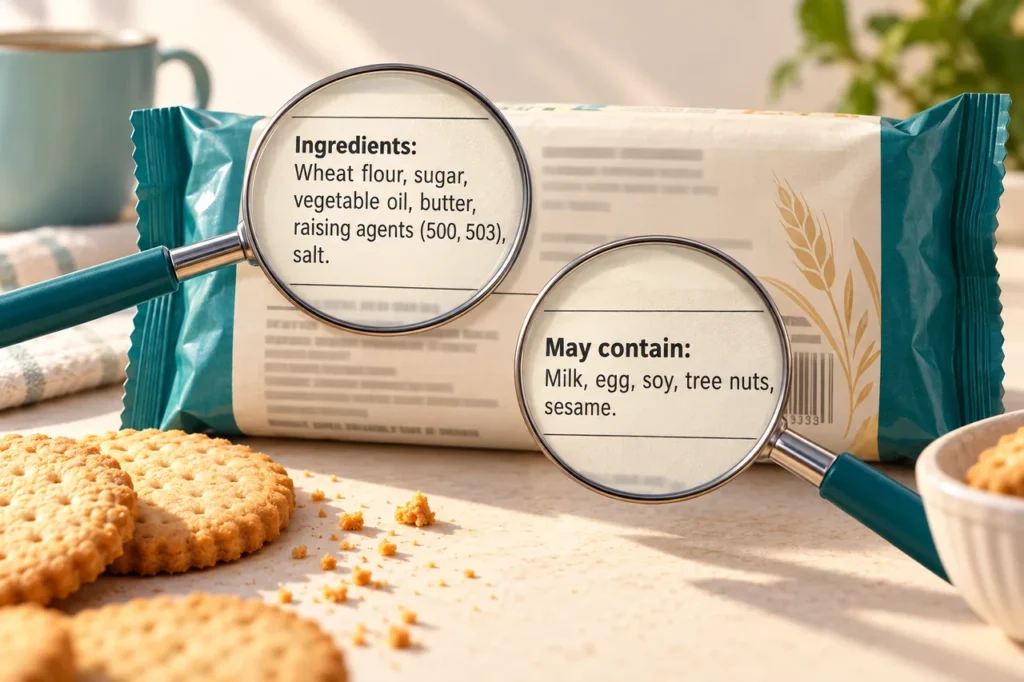
Illustrated packages and any label numbers are fictional teaching examples, not product specifications or evidence of safety. Follow the actual product instructions.
Useful checks
- Read the complete ingredient list
- Treat advisory wording as meaningful information
- Ask precise product-specific questions
Common mistakes
- Using missing May Contain text as proof of absence
- Testing an uncertain food by tasting it
Read ingredients and declarations together
Under FDA rules, major-allergen sources can be identified in ingredient wording or through a separate Contains statement. Do not scan only for a bold box and stop when there is none. For example, an ingredient name or parenthetical wording can identify the source. The packet you are buying matters more than a remembered formula from another flavor in the same product line.
What an advisory statement adds
Manufacturers may use statements such as May Contain or Made in a facility that also processes to address possible cross-contact. FDA explains that this advisory wording is voluntary and must not replace good manufacturing practices. It is not a statement that the named substance is intentionally part of the recipe. It also does not give a numerical contamination level or a personalized estimate of reaction risk.
Do not build a ranking from the wording
A shopper cannot reliably rank two packets as safer because one says shared equipment and another says may contain. The phrases do not supply a common measured scale. Equally, no advisory statement does not prove there was no possibility of cross-contact. If avoidance is important and the labeling leaves a question unresolved, ask the manufacturer for the relevant product information and follow individualized professional advice.
A useful product-information request
Keep the product name, package size, barcode and lot or date code available when asking a producer about unclear information. Specify the ingredient you need to avoid and quote the exact label wording rather than asking if a product is generally healthy. Keep a copy of the reply with its date, recognizing that a reply about one product or lot is not a permanent assurance for every future package.
Remember what this guide cannot decide
This is a label-reading guide, not a diagnosis, a challenge test or a recommendation to try a small amount of a questionable food. Do not taste food to investigate whether it contains an allergen. Be particularly careful with loose foods or prepared dishes that lack a complete label: ask for documentation instead of treating a visual inspection as evidence. Our image is a fictional teaching example, not an endorsed product label.
Common questions
Must every packet have a separate Contains box?
No. Relevant major-allergen information can be provided through compliant ingredient declarations as well. Read the full label.
Does May Contain mean the ingredient is definitely in every pack?
No. It is advisory cross-contact information, not a measured statement about each individual package.
References and scope
- FDA: Food Allergen Labeling Guidance, Edition 5 — Reference for major-allergen declarations and voluntary advisory statements.
Prepared October 24, 2026 with AI assistance. References support the stated guidance and do not endorse the entire article. Shopping examples are editorial examples, not product tests or medical advice.