
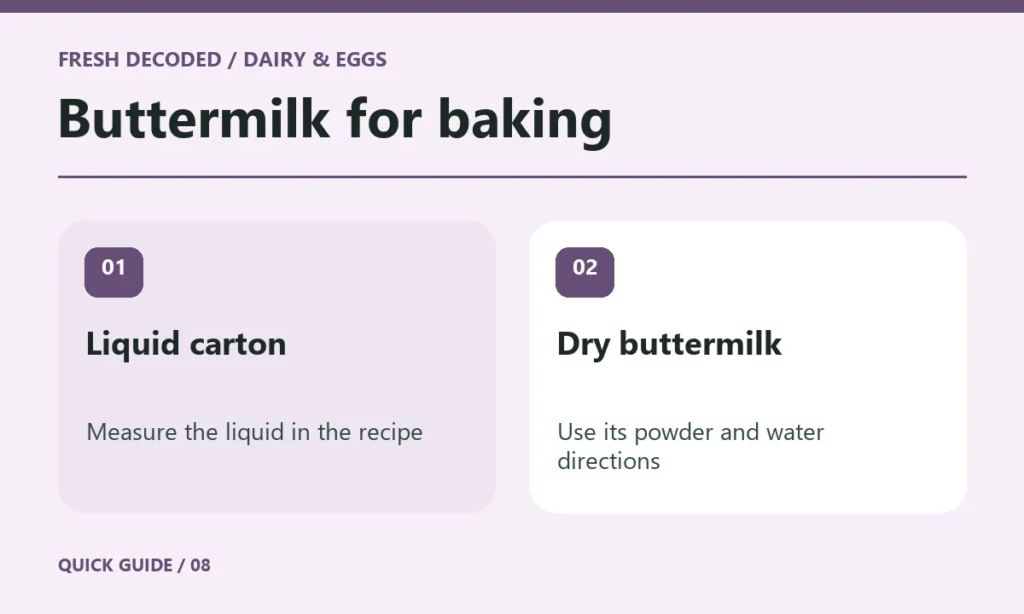
Liquid buttermilk goes into a recipe as a liquid. Dry buttermilk products need the quantity of powder and water stated on their own pack. If a biscuit recipe asks for one cup of liquid buttermilk, one cup of dry powder is not the substitute.
Read what the powder actually is
You may see dried buttermilk or a cultured buttermilk blend. Check the ingredients, then check the directions. King Arthur's dry buttermilk powder and Saco's cultured blend illustrate why the product names and mixing directions matter. Do not copy a ratio from a different powder or from an instant dry milk carton.
Keep the water in your recipe math
Some instructions tell you to mix the powder with dry ingredients and add the corresponding water with the wet ingredients. Others describe combining the powder and water first. Use the product's instructions together with a recipe written for that substitution. If you add both a full cup of liquid buttermilk and the powder plus its water, you have changed the liquid balance.
Say a fictional pancake recipe is written for a half batch and the package explicitly provides a powder-and-water equivalent for a full batch. Halve both measured amounts. Do not halve the powder while keeping all the water, and do not assume a scoop from a different container is the same measure. If the label does not give a usable conversion, buy the liquid ingredient specified or choose a recipe made for the powder.
Choose by how often you bake
For a recipe using most of a carton, the liquid version avoids conversion. If you bake small batches and have unused carton leftovers, a powder may make portioning easier. Compare the number of batches you can actually make rather than only the package size.
Check each product's storage directions after opening. A dry package that can sit unopened in the pantry is not evidence that the prepared mixture can be stored the same way.