
Mix dry milk using the directions on your own package. A scoop from another brand, a heaped spoon or an instruction for a different final volume can change the concentration and make recipe measurements unreliable.
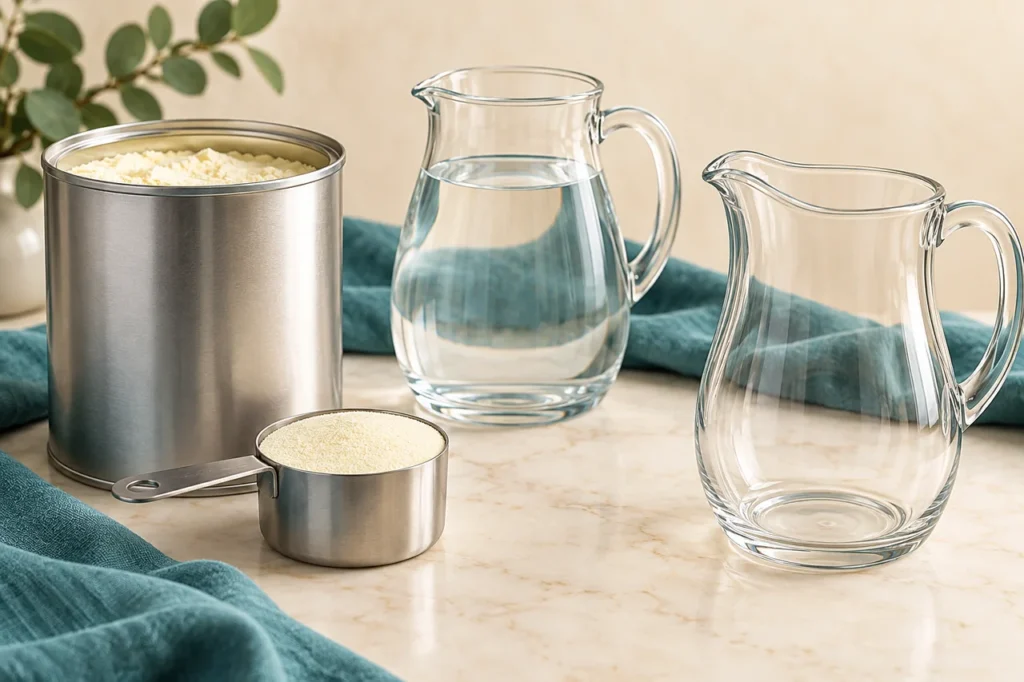
Illustrated packages and any label numbers are fictional teaching examples, not product specifications or evidence of safety. Follow the actual product instructions.
Useful checks
- Read the final-volume wording
- Scale powder and water together
- Label the prepared batch
Common mistakes
- Borrowing another product's scoop
- Using fictional example quantities on a real package
Distinguish water added from final volume
A direction may say to add a measured amount of powder to a stated amount of water, or it may describe the final prepared volume. Those are not the same instruction. Read the sequence and units before filling the pitcher. Adding powder to an already full vessel can change the final volume; do not assume that every mixing method tells you to fill the vessel first.
Use the measuring basis the manufacturer supplies
Some packages give spoon or cup measures; others also give a gram weight. If using a volume measure, use a proper measuring spoon or cup and follow the directions for level or packed measures. A mug, a random scoop and a kitchen tablespoon are not interchangeable tools. Where a gram amount is supplied, a suitable kitchen scale can make repeated batches more consistent.
A hypothetical half-batch exercise
Imagine your label calls for 40 g powder with 400 mL water. A half batch uses 20 g and 200 mL, following the same mixing method. These deliberately fictional numbers illustrate scaling and must not be used as instructions for a real milk product. Divide every specified ingredient by the same factor; do not halve the water while keeping a full scoop of powder.
Keep dry and prepared instructions separate
An unopened dry product and a pitcher of reconstituted milk have different storage requirements. Read what the package says about refrigeration and use after mixing. Label the prepared pitcher with the product identity and mixing date so someone else does not mistake it for an older batch. Use clean utensils and close the dry package to protect it from moisture. Retain the label rather than transferring powder to an anonymous jar.
Do not extend this method to infant feeding
This guide is about ordinary culinary dry milk, not infant formula, medical nutrition products or homemade replacements for them. Those products require their own precise preparation and professional guidance. For cooking, also distinguish reconstituted milk from adding dry powder directly to a dough: a baking recipe may intentionally use the latter. Follow the actual recipe rather than converting every dry ingredient into a drink first.
Common questions
Can I add extra powder for baking?
Only when the recipe intentionally calls for it. More powder changes the composition and is not a neutral mixing correction.
Is dry milk the same as evaporated milk?
No. They are different products with different recipe instructions.
References and scope
- Carnation: Instant Nonfat Dry Milk — Manufacturer product information. Mixing arithmetic is an editorial example, not that product’s preparation directions; read your own package.
Prepared October 24, 2026 with AI assistance. References support the stated guidance and do not endorse the entire article. Shopping examples are editorial examples, not product tests or medical advice.