
One package can contain several labeled servings. To estimate the nutrients in the amount you use, find the serving size, count how many of those servings you have and multiply the per-serving numbers by that amount.
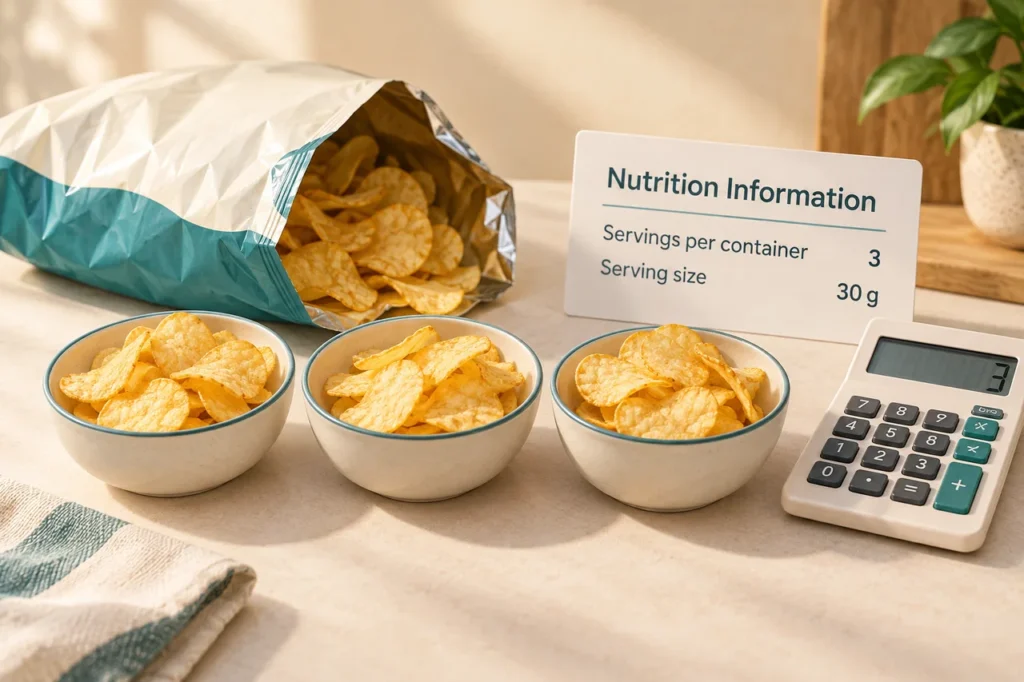
Illustrated packages and any label numbers are fictional teaching examples, not product specifications or evidence of safety. Follow the actual product instructions.
Useful checks
- Check per-serving versus per-package headings
- Match grams when comparing products
- Multiply by the servings actually used
Common mistakes
- Assuming one bag equals one serving
- Adding a prepared column to ingredients already counted
Find the label basis before doing arithmetic
The Nutrition Facts panel usually gives amounts for one serving, though some packages also provide a whole-container column. Read the heading over the numbers. FDA explains that serving sizes reflect amounts people typically consume; they are not a personalized recommendation for how much you should eat. A small-looking bag is not necessarily one serving simply because one person could finish it.
Work through a whole-package example
Imagine a fictional 90 g snack bag with three servings of 30 g and 160 calories per serving. Eating the whole package corresponds to three times the displayed calories: about 480. If the same fictional label lists 180 mg sodium per serving, the whole bag corresponds to about 540 mg. These are arithmetic examples, not measurements of any photographed or tested snack.
Calculate part of a container without guessing
Using that example, a measured 45 g portion equals 45 divided by 30, or 1.5 label servings. Multiply each per-serving amount by 1.5. Measuring once with a scale can show what that quantity looks like in your bowl. Do not assume that one bowl, handful or scoop always has the same weight; shape and how tightly it is filled change the amount.
Watch for prepared-food instructions
Powders, concentrates and foods mixed with another ingredient may show information for the product as packaged, as prepared, or both. Check which instructions the prepared column assumes. If you use another milk or a different quantity, the printed prepared figure may not describe your version. Keep the calculation on the same basis rather than adding a prepared value to ingredients already included in it.
Compare two packages fairly
Before choosing the product with the smaller printed number, compare the serving weights. A smaller per-serving value can simply reflect a smaller labeled serving. For a common-weight comparison, divide the nutrient amount by serving grams and multiply by the chosen comparison weight. Rounding and about-style serving counts make these estimates rather than exact chemical totals. Use them for a clearer shopping comparison, not a medical eating plan.
Common questions
Should I multiply the whole-package column again?
No. If that column already describes the complete package, multiplying again double-counts it.
Is the serving size telling me how much I personally need?
No. FDA distinguishes the labeling serving from a recommendation about your individual intake.
References and scope
- FDA: Serving Size on the Nutrition Facts Label — Reference for per-serving information, package columns and the meaning of serving size.
Prepared October 24, 2026 with AI assistance. References support the stated guidance and do not endorse the entire article. Shopping examples are editorial examples, not product tests or medical advice.