
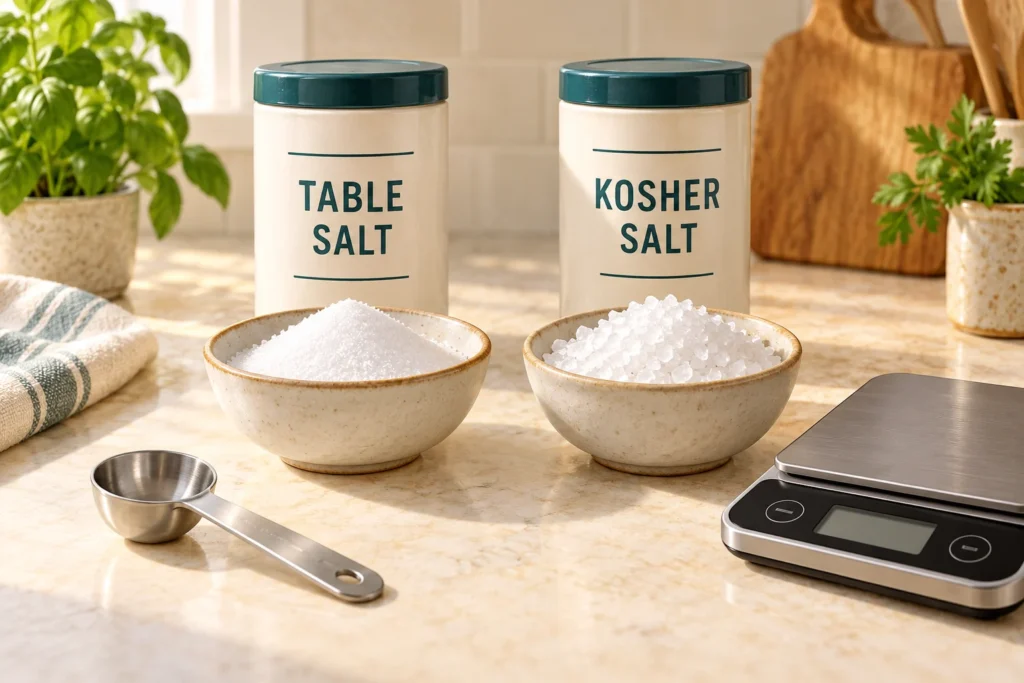
A teaspoon of kosher salt is not a universal replacement for a teaspoon of table salt. Crystal size and the particular product affect how much fits into a spoon. When shopping for a measured recipe, check the named salt and brand, and use the recipe’s gram amount when it provides one.
Prefer
- The recipe’s exact salt type and brand retained
- The recipe’s gram amount when supplied
- Product-specific conversion guidance for the actual salt
Avoid / check more closely
- One universal teaspoon rule for every kosher salt
- Using a seasoning blend as plain salt without instructions
- Treating larger crystals as a health or safety verdict
The shopping detail that is easy to miss
A list that says only salt can omit a detail the recipe actually specifies. Before going to the store, copy the full ingredient line and check its notes. If it names table salt or a particular kosher salt, retain that wording. This is especially useful when another person buys the groceries: a photograph of your preferred package plus its exact product name is clearer than asking for the usual salt.
Why an equal spoonful can differ
King Arthur explains that salt crystals of different sizes fit into a measuring spoon differently. Its baking guidance recommends retaining the recipe’s gram measurement when using another ordinary salt type. That does not mean every product sold near salt is interchangeable: seasoning blends and salt substitutes need their own recipe guidance. Read the actual product description rather than treating a similar container as confirmation.
A published weight comparison makes it concrete
King Arthur’s current ingredient chart lists one tablespoon of Diamond Crystal kosher salt at 8 grams, Morton kosher salt at 16 grams, and table salt at 18 grams. These are the chart’s approximate ingredient equivalents, not measurements made by Fresh Decoded. In that comparison, the two kosher entries differ substantially even though both use the same category name. Do not generalize one brand’s spoon measurement to every bag marked kosher salt.
Use the recipe’s weight when it is available
Suppose a recipe specifies 8 grams of an ordinary salt. Use that stated weight with a scale suitable for measuring the small amount, rather than converting it through a spoon rule remembered from another brand. Check the scale’s instructions and resolution; a display that cannot resolve the required amount is not helpful for that measurement. If the recipe provides only volume, follow its specified product or ask its developer for a suitable substitution.
Conversion guidance has a scope
Morton publishes a conversion chart for its salt products. Use the chart’s exact product columns and the quantity relevant to your recipe; do not treat it as a brand-independent rule for all kosher salts. Different recipe resources may use different approximate volume conventions. If guidance appears inconsistent, return to the recipe’s named product and weight instead of averaging two online ratios. A clear instruction is more useful than a confident but unsupported conversion.
Separate recipe performance from health claims
This guide concerns measurement and ingredient selection. Coarse crystals, a premium package, or the word kosher do not establish that the product is healthier or suitable for a particular dietary requirement. Read the full label for your actual purchase. The illustration is a visual explanation of two product types; it is not a calibrated comparison of crystal size, sodium content, or food safety.
Keep the product identity after decanting
If you move salt into a kitchen jar, label it with the original product type and brand, and retain its package information. When changing brands, update the jar label rather than leaving the old name in place. Keep a short note with the recipes that depend on a specific measurement. This prevents a later baking session from beginning with an unknown ingredient and an assumption about how much one spoon contains.
Common questions
Are all kosher salt brands identical by volume?
No. King Arthur’s chart gives different tablespoon weights for Diamond Crystal and Morton kosher salt. Check the specific product.
Should I double every kosher-salt measurement?
No. That is not a universal rule. Use the recipe’s weight, named product, or a relevant manufacturer/developer conversion.
References and scope
- King Arthur Baking: Is There a Best Salt for Baking?
- King Arthur Baking: Ingredient Weight Chart — salt types and brands
- Morton Salt: Salt Conversion Chart — manufacturer-specific guidance
Sources support the specific factual points attributed to them. Shopping scenarios and checklists are Fresh Decoded editorial suggestions; the sources do not endorse this article. Prepared October 9, 2026 with AI assistance. No product testing or medical review is claimed.