
For a recipe that will not thoroughly cook its eggs, look for eggs or egg products explicitly labeled pasteurized. Organic, free-range, brown-shell and a high quality grade do not make the same statement about treatment.
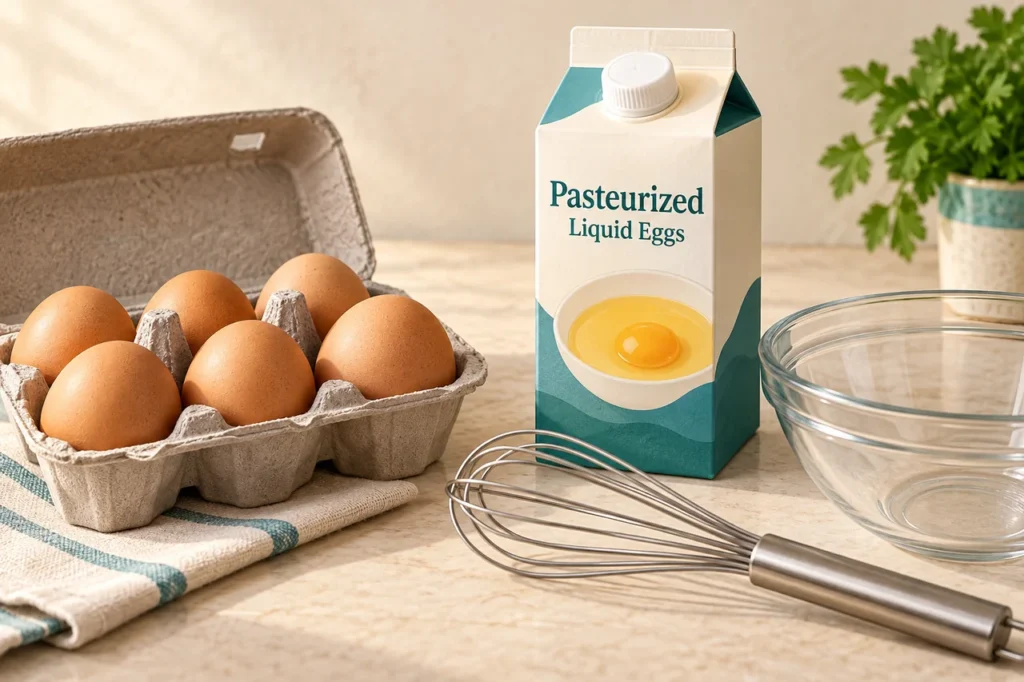
Illustrated packages and any label numbers are fictional teaching examples, not product specifications or evidence of safety. Follow the actual product instructions.
Useful checks
- Identify whether the recipe cooks the eggs
- Read the explicit treatment statement
- Match whole eggs, whites or yolks to the recipe
Common mistakes
- Equating organic with pasteurized
- Guessing liquid-egg replacement quantities
Identify what your recipe is asking the eggs to do
A homemade dressing, an uncooked dessert and a baked cake are different preparations. Before buying, check whether the recipe includes a reliable cooking step or expects the eggs to remain uncooked. FDA advises using pasteurized eggs or egg products for recipes served raw or undercooked. This is a product-selection decision, not a reason to improvise a home pasteurization process.
Read pasteurized on the egg product itself
Pasteurized shell eggs look like ordinary shell eggs, so appearance is not enough. Find the treatment statement on the carton. For liquid products, distinguish whole egg, egg white and a formulated substitute by reading the product name and ingredients. A carton format does not tell you which part of the egg it contains. Do not treat a plant-based substitute as compositionally identical to a pasteurized whole egg.
Check the recipe quantity against package directions
A recipe calling for two eggs cannot always be translated into two arbitrary spoonfuls of a liquid product. Use the manufacturer equivalence, where provided, and check whether the recipe needs yolks, whites or both. The same shopping logic applies to foaming and binding: buying a pasteurized white product does not supply yolks for a recipe that needs them. We have not tested how particular brands perform in a recipe.
A practical dressing-shopping example
If you intend to make a dressing with uncooked egg, first choose a recipe that specifies an appropriate pasteurized product. At the store, read the treatment statement, then the ingredient and use instructions. Pick a package size you can use within its opening directions. Alternatively, consider a commercially prepared dressing that meets your ingredient requirements. The point is to choose a documented preparation, not to argue that fresh-looking ordinary eggs are equivalent.
Treatment does not remove handling responsibilities
Follow refrigeration and use-after-opening instructions, use clean utensils and keep raw animal-food juices away from the finished mixture. Pasteurized does not mean that an opened carton can sit on the counter indefinitely. Do not use the float test or a photograph to verify whether eggs were treated. If the carton does not answer your question, contact the producer or choose a clearly described product.
Common questions
Does Grade AA mean pasteurized?
No. A quality grade and a treatment statement answer different questions.
Can I identify pasteurized shell eggs by their color?
No. Use the package statement rather than shell or yolk color.
References and scope
- FDA: eggs in uncooked preparations — Reference for pasteurized egg choices and differences among egg products. Recipe-shopping examples are editorial.
Prepared October 24, 2026 with AI assistance. References support the stated guidance and do not endorse the entire article. Shopping examples are editorial examples, not product tests or medical advice.