
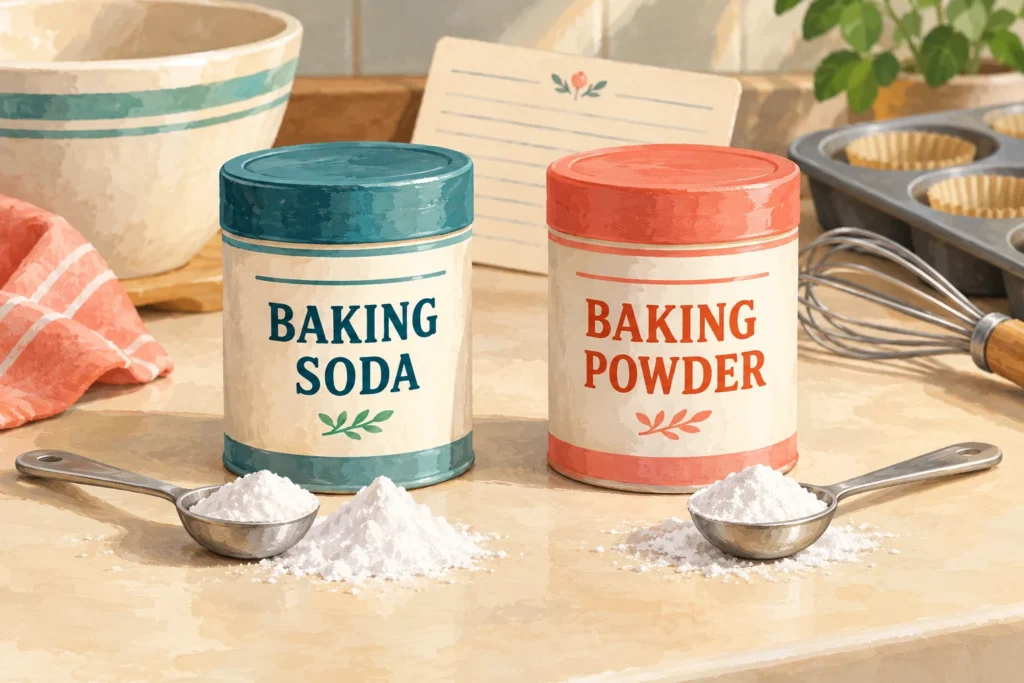
Baking soda and baking powder are different ingredients, even when their containers hold similar-looking white powder. Buy the one named in your recipe and check the full product label. Swapping equal spoonfuls is not a reliable shortcut for a missing ingredient.
Prefer
- The exact leavener named in the recipe
- Required product wording checked before buying
- Clearly labeled containers and measured quantities
Avoid / check more closely
- Equal-spoon swaps without recipe instructions
- Using an unmarked powder jar
- Guessing an ingredient from its appearance
Understand the practical difference
King Arthur Baking explains that baking soda needs an acidic partner in a recipe, while baking powder contains both a base and an acid. That difference matters to how a recipe is designed. You do not need to redesign the chemistry at the supermarket: use the recipe’s ingredient list as your purchase guide, and keep soda and powder separate on it.
Check double-acting wording when the recipe expects it
King Arthur’s recipe-success guide specifies double-acting baking powder for its recipes. Check the product wording when following those recipes, rather than assuming every packet is identical. If you are using another recipe, read its own requirements. A recipe’s named product type is more useful than choosing the container with the most attractive muffin picture on the front.
Read the complete ingredient line in the recipe
Write down both the name and quantity before shopping. For example, a recipe may call for baking soda and baking powder separately; having one jar does not automatically cover both lines. Also distinguish teaspoons from tablespoons when measuring later. A clear shopping list can read baking powder — double-acting, rather than a vague baking ingredient that is easy to misremember at the shelf.
Do not use a spoon-for-spoon substitution
King Arthur warns that equal amounts of baking soda and baking powder cannot simply be substituted for one another. If you are missing one, consult substitution instructions for the complete recipe or choose another documented recipe. Do not copy a ratio from an unrelated cake and assume it works for your cookies. An unfamiliar swap is a recipe change, not a test of whether two packages look alike.
Choose a manageable pack and keep it identifiable
Consider how often you bake before buying a very large container. Check the closure and the manufacturer’s storage directions. Keep the original label, date wording, and opening information where you can find them; if you use outer food storage, label it clearly. A white powder in an unmarked jar creates needless uncertainty when several baking ingredients are on the counter.
A useful preparation checklist
Before mixing, place the recipe beside the two containers and read each name again. Measure the specified ingredient with suitable measuring tools, then close its container before moving on. If you notice you bought the wrong product, resolve the recipe choice before preparing the rest of the mixture. Do not taste a powder or raw batter to identify an ingredient; the label is the information you need.
Common questions
Can I replace a teaspoon of baking powder with a teaspoon of baking soda?
Do not make an equal-spoon swap. Use suitable instructions for the complete recipe instead.
Does a recipe sometimes need both?
Yes. King Arthur explains that some recipes use both. Keep the two ingredients distinct rather than combining their listed quantities.
References and scope
Sources support the specific factual points attributed to them. Shopping scenarios and checklists are Fresh Decoded editorial suggestions; the sources do not endorse this article. Prepared October 9, 2026 with AI assistance. No product testing or medical review is claimed.