
There are three safe ways to thaw frozen food: in the refrigerator, in cold water, or in the microwave — and thawing on the kitchen counter is not one of them. Fridge thawing is easiest and safest: move food from freezer to fridge (at or below 40°F / 4°C) and allow roughly 24 hours for every 4–5 pounds of a large item, or overnight for typical portions. Cold-water thawing is faster — change the water every 30 minutes and cook immediately afterwards — while microwave thawing is fastest but the food must be cooked straight away. Perishable food left above 40°F for more than two hours should be discarded.
Prefer
- Thawing in the fridge on a drip tray
- Cold water, changed every 30 minutes
- Microwave thawing followed by immediate cooking
- Planning a day ahead for large items
- Cooking cold-water or microwave-thawed food at once
Avoid / check more closely
- Thawing on the counter or in hot water
- Leaving perishable food out over two hours
- Refreezing raw thawed meat without cooking
- Thawing in a leaking bag in the sink
- Guessing doneness after uneven microwave thawing
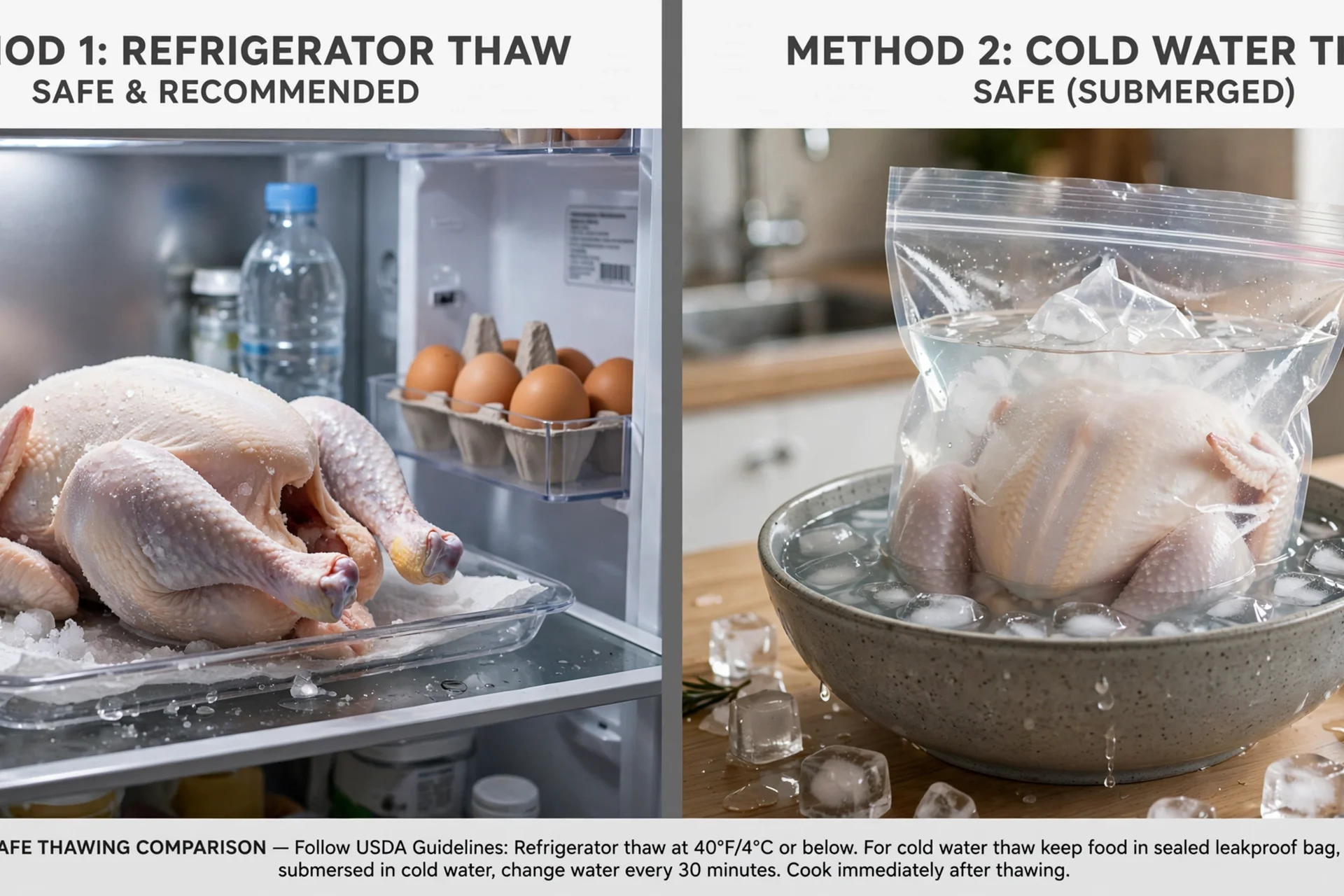
Method one: the refrigerator (plan ahead, worry-free)
Fridge thawing keeps food at a safe, steady temperature the whole time, so it is the method to default to. Put the frozen item on a tray or plate on the lowest shelf to catch drips, and allow time: small portions overnight, a whole chicken a day or more, a large turkey roughly a day per 4–5 pounds. Food thawed this way keeps like fresh — ground meat, poultry, and seafood should be cooked within one to two days, red meat cuts within three to five. Special care applies to some seafood: the guidance in thawing vacuum-packed fish explains why sealed vacuum packs should be opened before fridge thawing.
Method two: cold water (fast, with attention)
For same-day thawing, submerge the food — only if it is in a leak-proof bag — in cold tap water, changing the water every 30 minutes so it stays cold. Small portions thaw in about an hour; a 3–4 pound item in two to three hours. Never use warm or hot water, which pushes the surface into the temperature range where bacteria multiply quickly while the center is still icy. Cook the food immediately after cold-water thawing. Because raw juices and drips are involved, the same hygiene covered in how to store meat applies: clean the sink and surfaces afterwards, and keep thawing meat away from ready-to-eat foods.
Method three: microwave, and cooking from frozen
Microwave thawing with the defrost setting works for portions you will cook immediately — it can start to cook thin edges, so transfer the food straight to the pan, oven, or grill, and check thick items reach a safe temperature throughout. Many foods can also be cooked from frozen with no thawing at all: vegetables, burgers, and casseroles simply need extra cooking time, often about 50% longer. In fact, how to freeze vegetables notes most frozen vegetables are designed to go straight into the pot, making them the lowest-effort option of all.
Refreezing rules and the danger zone
Food thawed in the fridge can be refrozen without cooking if it has stayed cold and is within its use window, though quality drops each cycle. Food thawed by cold water or microwave must be cooked before any refreezing. The rule behind all of this is the danger zone — roughly 40–140°F (4–60°C) — where bacteria can double quickly; that is why counter thawing fails, since the surface sits in that zone for hours while the middle is still frozen. When perishable food has been left out for more than two hours (one hour in very hot conditions), discard it rather than tasting to check.
Common questions
Why can’t I thaw food on the counter?
The outside reaches room temperature and stays there for hours while the center is still frozen, giving bacteria ideal conditions on the surface. The fridge, cold water, and microwave all keep food cold enough or move it through quickly.
How long does fridge thawing take?
About 24 hours for every 4–5 pounds of a large item like a turkey; typical portions of meat, poultry, or fish thaw overnight. Keep the food on a tray to catch drips.
Can I refreeze thawed food?
Fridge-thawed food that stayed cold can be refrozen, with some quality loss. Food thawed in cold water or the microwave must be cooked first, then it can be frozen as a cooked dish.
References
U.S. Department of Agriculture, Food Safety and Inspection Service — The Big Thaw. Reference for the three safe thawing methods: refrigerator, cold water, and microwave.
Prepared October 21, 2026 with AI assistance. Cited sources do not endorse the entire article.