Misleading packaging usually works through emphasis rather than outright lies: big promises on the front, important details in tiny print on the back. The fix is simple — turn the package around and read the nutrition facts, ingredient list, and serving size before you decide. A few minutes of label comparison will teach you more than any front-of-package badge.
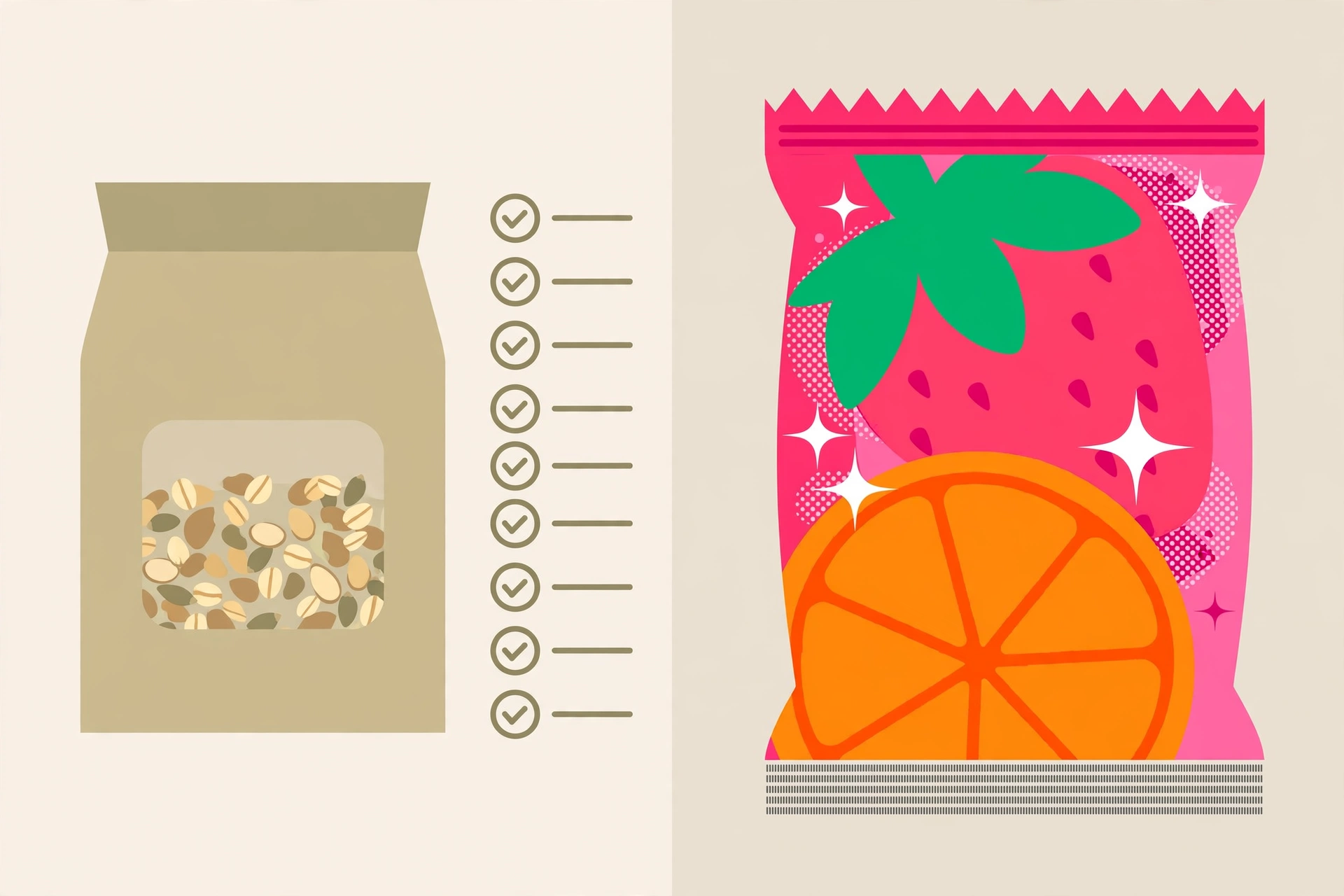
Prefer
- Read the nutrition facts panel before believing any front-label claim.
- Check the serving size first — every number on the panel depends on it.
- Scan the first three ingredients — they make up most of what is inside.
- Compare products per serving or per 100 grams, not by the size of the package.
- Look at the net weight, not the height of the box or bag.
- Treat front-of-package badges as marketing until the back panel confirms them.
Watch out for
- Oversized claims like “natural,” “light,” or “made with real fruit” with no detail behind them.
- Unrealistically small serving sizes that make calories and sugar look low.
- Pictures of ingredients that appear near the end of the ingredient list — or barely at all.
- “No added sugar” on products that are still high in total sugars.
- Slack fill and shrinking contents — tall boxes and bags that hold less than they suggest.
- Health-halo words with no regulated meaning doing the heavy lifting for the product’s image.
Why the front of the package is advertising
The front of a food package is prime marketing space. Every word, badge, and picture there was chosen to make you pick up the product — not necessarily to inform you. The regulated information, the nutrition facts panel and the ingredient list, lives on the back or side, where fewer shoppers look.
This does not mean every front-label claim is false. It means the front tells you what the maker wants you to notice, while the back tells you what is actually inside. Building the habit of flipping the package is the single most useful label-reading skill.
Serving size: the number that changes everything
Serving size is the lens through which the whole nutrition panel must be read. A snack that lists 100 calories per serving looks modest — until you notice the serving is a handful of chips and the bag holds four servings. Always check “servings per container” right below it.
Serving sizes are meant to reflect typical portions, but they can still be smaller than what people actually eat. When comparing two products, do the quick math to a common base, such as per 100 grams, so you are comparing fairly instead of comparing marketing choices.
Ingredient lists tell the real story
Ingredients are listed in descending order by weight, which makes the first three the most revealing part of any label. If sugar or a syrup appears among them, the product is largely built on it — no matter what the front of the package suggests.
Further down, the “contains 2% or less of” section covers minor ingredients, including many flavorings and preservatives. A long tail of unfamiliar names is not automatically bad, but a short list of recognizable ingredients is usually easier to understand at a glance.
Claims that deserve a second look
Some words sound meaningful but carry little regulated weight. “Natural,” for example, is not strictly defined for most foods, so it functions mainly as marketing. “Light” or “lite” can refer to color or texture rather than calories, and “made with real fruit” may describe a tiny fraction of the contents.
“No added sugar” is another classic: it can be true while the product remains high in total sugars from fruit juice concentrates or naturally sweet ingredients. The pattern is always the same — a true statement in big letters, with the fuller picture waiting in the nutrition panel.
A simple package-check checklist
- Flip the package: read the back panel before the front claims.
- Check the serving size and the servings per container.
- Read the first three ingredients.
- Compare net weight and unit price, not package height.
- Question big claims, then verify them against the nutrition facts.
- When two products seem similar, the plainer label is often the more honest one.
Common questions
Does “natural” on a label mean anything specific?
Not much on its own — the term is not strictly defined for most foods, so it works mainly as marketing language. If you want to know what is inside, the ingredient list will tell you far more than the word “natural” ever could.
Is a bigger package always better value?
Not necessarily. Compare the unit price and the net weight rather than the size of the box. Packages quietly shrink their contents while keeping the same tall box, so the shelf price alone can mislead.
Should I trust front-of-package health badges?
Treat them as a starting point, not a conclusion. Badges highlight whatever the maker most wants you to notice; the nutrition facts panel shows the fuller picture. A minute of comparison beats a moment of badge-trusting.
References
- U.S. Food and Drug Administration — Food Labeling
- U.S. Federal Trade Commission — Truth in Advertising
Prepared October 8, 2026 with AI assistance. Cited sources do not endorse the entire article.