
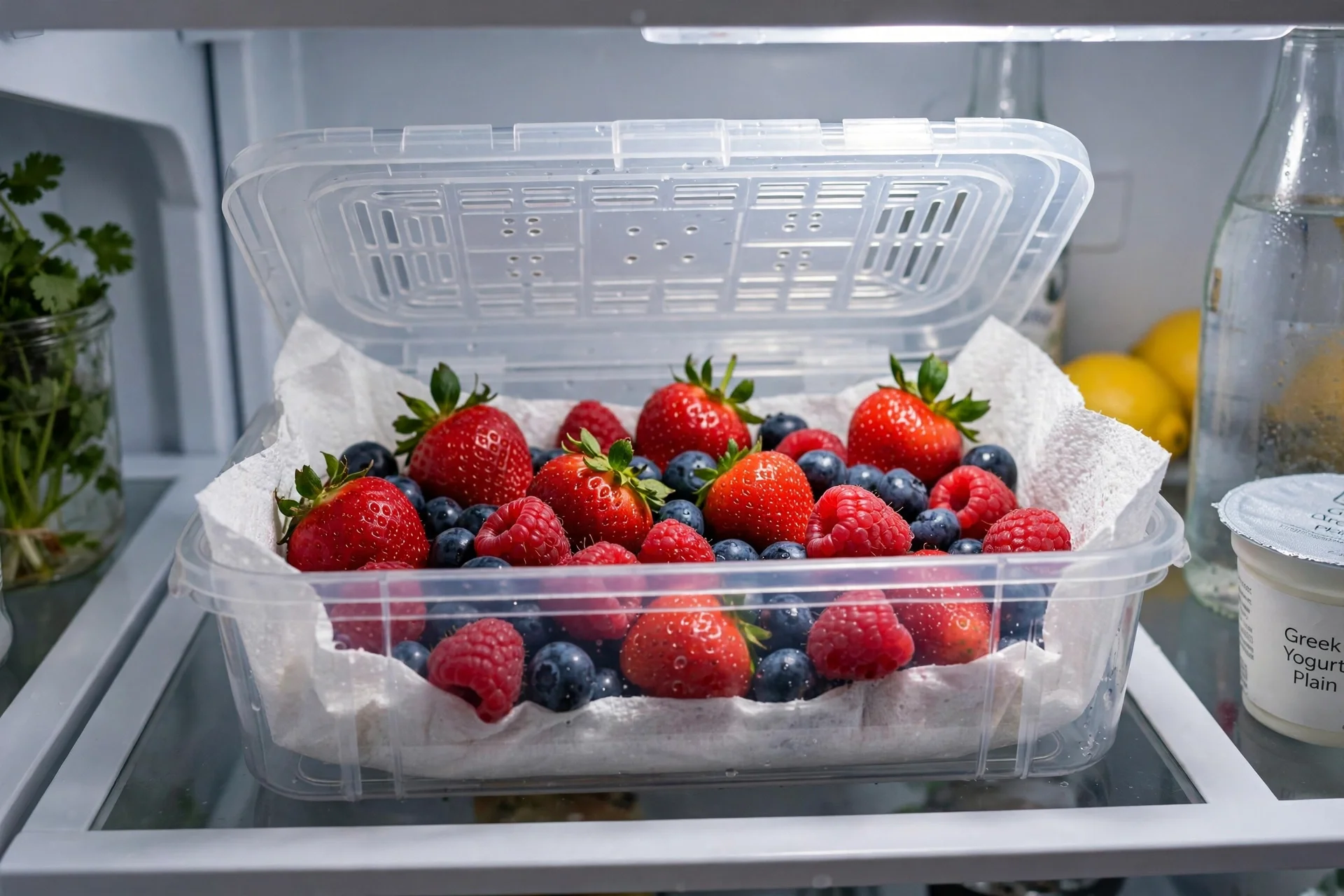
To make berries last longer, refrigerate them unwashed in a ventilated container lined with a dry paper towel, and remove any moldy or crushed berries before storing — one moldy berry spreads quickly to its neighbors. Keep the fridge at or below 40°F (4°C), avoid sealing warm berries in an airtight box, and wash berries only just before eating, since added moisture is the main driver of mold. Most berries keep two to five days this way; if you cannot use them in time, freeze them instead of watching them spoil.
Prefer
- Refrigerating promptly, unwashed
- A paper-towel layer to absorb moisture
- Removing moldy or crushed berries first
- Ventilated container, not airtight
- Washing only just before eating
Avoid / check more closely
- Washing berries before refrigerating
- Leaving a moldy berry in the pack
- Sealing warm berries in a closed box
- Storing berries at room temperature
- Piling delicate raspberries deeply
Dry, cold, and unwashed is the whole secret
Berries spoil for one main reason: surface moisture plus mold spores that are already present. Refrigeration slows both, but only if the berries go in dry. Spread them in their original ventilated clamshell or a shallow container lined with a paper towel, which wicks away condensation. The picking advice in how to choose strawberries matters here too — berries bought dry and undamaged simply outlast a pack that was already leaking in the store. Strawberries keep their green tops on during storage; hull them after washing, at serving time.
Sort first, and give mold nowhere to spread
Before the container goes in the fridge, spend thirty seconds sorting. Eat or discard anything moldy, mushy, or leaking — mold spreads berry-to-berry by contact, so leaving one fuzzy fruit undoes the whole pack. This is doubly true for raspberries and blackberries, whose hollow, delicate structure traps moisture; store them in a single shallow layer if you can. Blueberries are sturdier, and the firm, bloom-covered fruit picked using how to choose blueberries will usually keep the longest of the common berries, up to a week refrigerated.
Washing, the vinegar-rinse question, and serving
Wash berries under cool running water immediately before eating, drain well, and pat dry. Some cooks rinse berries in a diluted vinegar bath (roughly one part vinegar to three parts water), then rinse, dry thoroughly, and refrigerate; thorough drying afterwards is the step that makes or breaks that method — wet berries mold faster, treated or not. The same caution applies to the delicate fruit in how to choose blackberries: handle gently, keep dry, and let berries sit at room temperature for 15–20 minutes before serving so their flavor opens up, then return leftovers to the fridge promptly.
Freezing berries before they turn
If day three arrives and the berries will not be eaten, freeze them rather than hoping. Rinse, dry very well, spread in a single layer on a lined tray, freeze until solid, then bag them with the air pressed out and label with the date. Frozen berries keep for several months and are ideal for smoothies, sauces, oatmeal, and baking, though they soften on thawing and are less suited to eating out of hand. Freezing slightly soft but sound berries is fine; moldy berries should be discarded, not frozen.
Common questions
Should I wash berries as soon as I get home?
No — washing adds the moisture that speeds mold. Keep berries dry and unwashed in the fridge, and rinse them under cool water just before eating.
One berry is moldy — is the whole pack ruined?
Remove the moldy berry and any it touched directly, then inspect the rest. Sound, firm berries that show no mold can be washed and eaten soon; when mold is widespread through the pack, discard it.
How long do berries keep in the fridge?
Typically two to five days depending on the type and condition at purchase: raspberries are shortest at one to three days, strawberries around three to five, and blueberries up to about a week.
References
U.S. Food and Drug Administration — Selecting and Serving Produce Safely. Reference for selecting, storing, and serving fresh produce safely.
Prepared October 21, 2026 with AI assistance. Cited sources do not endorse the entire article.