
When buying scallops, read both the product description and the ingredient information for added water or phosphates. Do not try to identify processing from whiteness, size, or liquid in the tray. A clear label and a specific question to the seller are more useful than guessing from appearance.
Prefer
- Both product identity and ingredient information checked
- A specific question about added water and phosphates
- Cold storage and intact packaging checked separately
Avoid / check more closely
- Estimating moisture percentages from appearance
- Using premium wording instead of product details
- Treating an ingredient preference as a safety verdict
Why the processing information matters
The NOAA Seafood Inspection Program’s manual discusses scallop processing that adds moisture or phosphates and the need for that treatment to be reflected in product identity and ingredients. Its guidance is a U.S. inspection-program source, not a promise that every retailer worldwide uses identical wording. For shopping, the useful step is to check whether the product is described clearly enough to meet your requirements.
Read more than the large word scallops
On a packaged product, check the full description, then read the ingredients. Look for information about water and a named phosphate, such as sodium tripolyphosphate. Do not stop at a large scallop photograph or assume an attractive front label lists everything. If your aim is a product without added water or phosphate treatment, ask for that explicitly and verify the manufacturer’s information. An unclear ingredient description is a reason to ask, not a reason to invent a conclusion.
Ask a precise question at a seafood counter
Try: Does this product have added water or any phosphate treatment, and can I see the supplier’s ingredient information? That request is clearer than asking whether the scallops are good or premium. If the seller cannot establish the details, choose a product with information you can verify or change your meal plan. Keep any label supplied with a repacked purchase so you have the same details when you prepare it at home.
Use a realistic side-by-side comparison
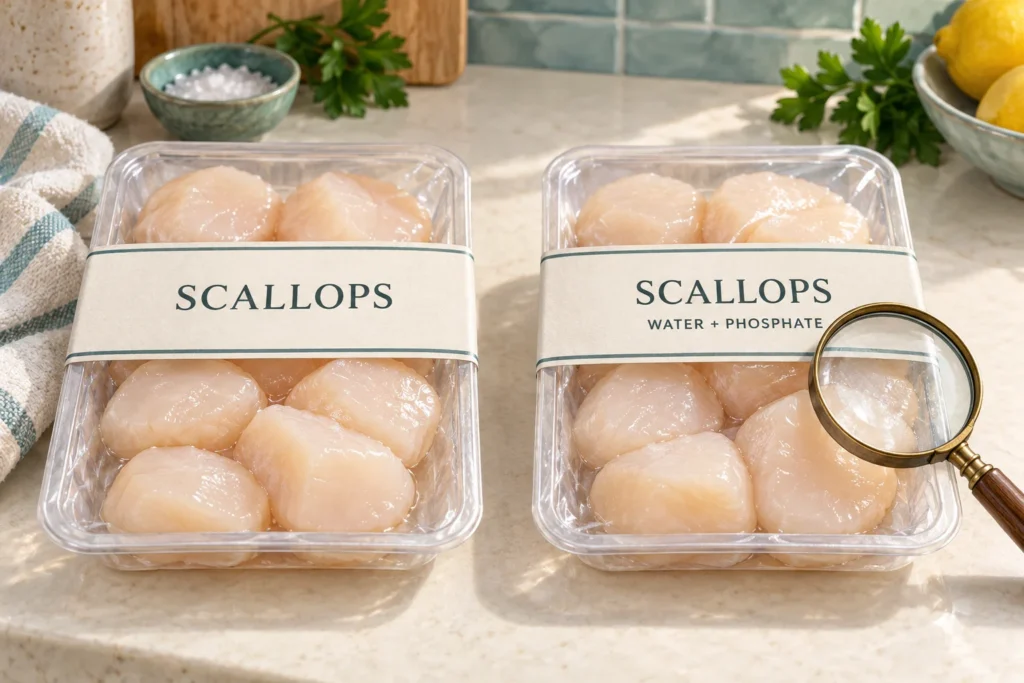
Suppose two hypothetical packages have similar prices and weights. One identifies only scallops in its ingredients; the other declares scallops plus water and sodium tripolyphosphate. They are differently described products. If your recipe or preference requires the first description, the lower price of the second does not make it an equivalent purchase. This example is a shopping exercise, not a laboratory check of either package or a claim about an actual brand.
Do not calculate hidden moisture from a photograph
NOAA’s manual describes laboratory moisture testing within its inspection procedures. A shopper looking at the tray cannot perform that analysis by judging how white, large, or wet the scallops seem. Visible liquid also does not provide a reliable numerical estimate of added water. Use the label and verified supplier information; avoid repeating a made-up percentage or describing the illustration as evidence of treatment in real seafood.
Keep the cold-chain check separate
Processing information does not establish safe storage. The FDA advises buying refrigerated seafood or seafood displayed on a thick bed of fresh ice, and avoiding frozen seafood packages that are open, torn, or crushed. It recommends prompt cold storage; seafood intended for use within two days should be refrigerated at 40°F or below, approximately 4°C. Follow the actual product instructions as well. A clearly described scallop still needs proper handling.
Make a short shopping note
Before leaving home, record the scallop form and quantity your recipe requests, whether you need a particular ingredient description, and when you plan to prepare it. At the store, verify those details and retain the handling instructions. You do not need to rank every scallop on the shelf. Your goal is a purchase that matches the planned dish with enough product information to use it responsibly.
Common questions
Does a phosphate listing prove the scallops are spoiled?
No. It identifies processing information; it is not a spoilage test. Check handling and product instructions independently.
Can I verify an ingredient-free claim from the picture here?
No. These fictional labels illustrate a reading exercise. Obtain the complete information for the actual product you intend to buy.
References and scope
- NOAA Seafood Inspection Manual, Part 4 — Scallop Moisture Determination, pages 26–28
- FDA: Selecting and Serving Fresh and Frozen Seafood Safely
Sources support the specific factual points attributed to them. Shopping scenarios and checklists are Fresh Decoded editorial suggestions; the sources do not endorse this article. Prepared October 9, 2026 with AI assistance. No product testing or medical review is claimed.