
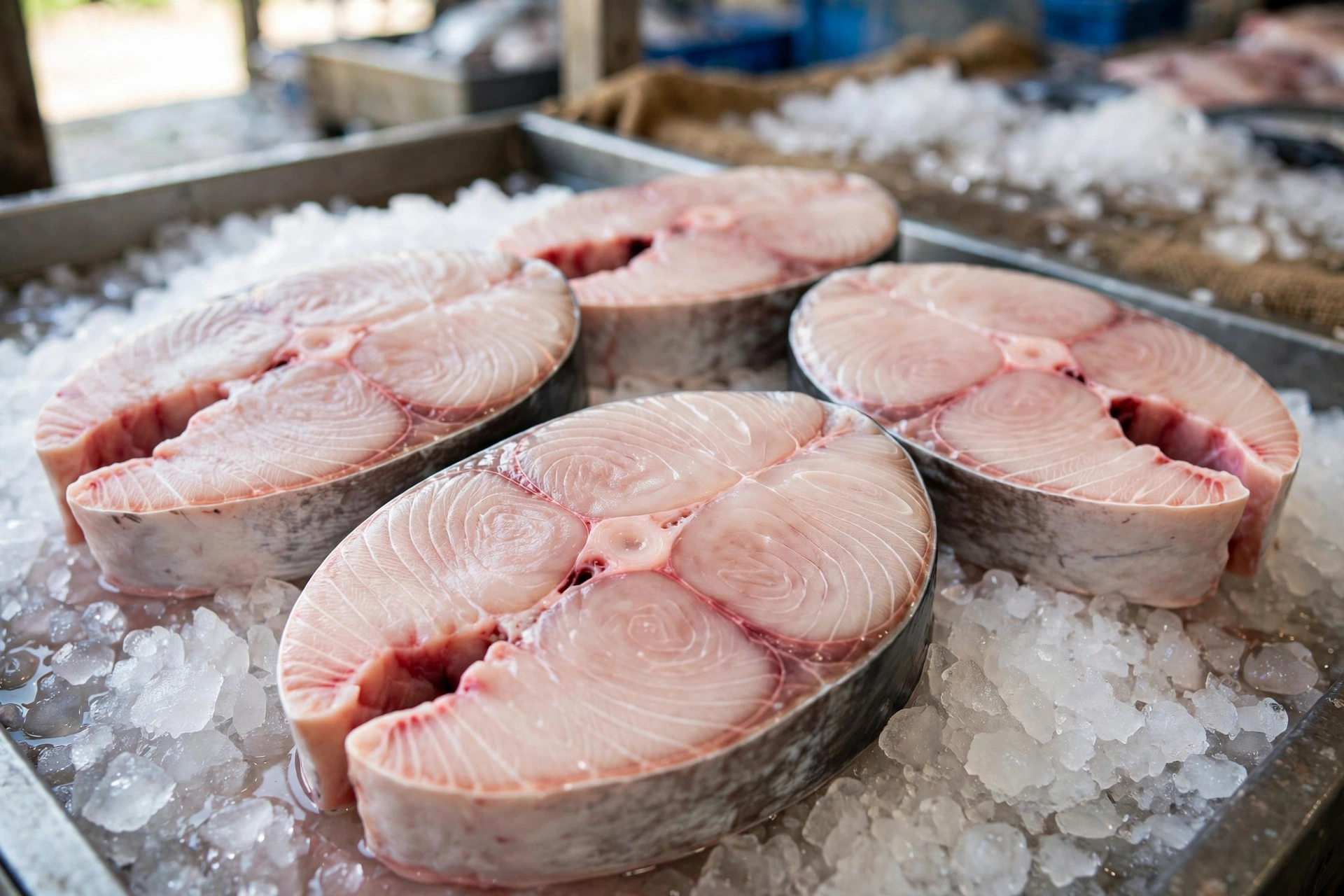
To choose good swordfish, look for steaks that are firm, moist, and ivory-white to pale pink, with a clean, mild ocean smell. The flesh should feel dense and spring back when pressed, with no browning along the edges. Avoid steaks that look dull or dry, feel soft, show brown discoloration, or smell strongly fishy or sour. Choose steaks of even thickness — around an inch — so they cook through uniformly.
Prefer
- Firm, dense flesh that springs back
- Ivory-white to pale pink color
- Moist, glistening surface
- Mild, clean ocean smell
- Even thickness around one inch
Avoid / check more closely
- Soft or mushy texture
- Brown or yellow discoloration
- Dry, dull-looking surface
- Strong fishy or sour odor
- Very thin or uneven steaks
Density and color
Swordfish is a dense, meaty fish, and freshness shows in its firmness. Press the steak: it should feel solid and rebound, not yield softly or crumble. Color should be ivory to light pink; a slightly translucent look is fine. Browning at the edges or a generally dull, matte surface indicates oxidation and age — the steak may still be safe if it smells fine, but the flavor will be flatter. Some darker red-brown muscle along the center is normal in swordfish; it tastes stronger, and you can trim it if you prefer a milder flavor.
Smell and the bloodline
Fresh swordfish smells faintly of the sea — clean and mild. Because it is a large, oily fish, any strong, sour, or ammonia-like smell is a clear reject. Check the bloodline, the darker strip running through the steak: it should look reddish-brown, not black or greenish. An off smell concentrated at the bloodline while the rest smells fine is still a reason to pass, since those compounds spread.
Steak cut and sustainability
Swordfish is almost always sold as steaks, and an even one-inch thickness is ideal — thick enough to stay juicy, thin enough to cook through without charring the outside. Very thick center-cut steaks from large fish can be excellent but need gentler heat. On sustainability, look for harpoon- or handline-caught swordfish, which avoids the bycatch associated with longlines; many retailers label the catch method. North Atlantic stocks are generally considered better managed than some other regions.
Storing swordfish at home
Refrigerate swordfish immediately and cook within one to two days. Keep it in the coldest part of the fridge, wrapped tightly to prevent drying. For longer storage, wrap steaks airtight and freeze for up to three months; thaw overnight in the refrigerator. Swordfish is lean for an oily fish and dries out if overcooked, so watch it closely — it is done when just opaque through the center.
Common questions
Why does swordfish sometimes taste strong?
The dark red-brown muscle (bloodline) has a much stronger flavor than the pale flesh. Trimming it away before cooking gives a milder result. Older fish also tastes stronger, so freshness matters.
Is the white flesh or pink flesh better?
Both are normal — color varies with diet and the individual fish. Judge by firmness and smell rather than the exact shade.
Can swordfish be eaten rare?
Swordfish is often served medium to medium-well because its dense texture benefits from thorough cooking, and, like all fish, it should reach a safe internal temperature. Very fresh, sushi-grade swordfish is sometimes served rarer, but that is a judgment call for high-quality sources.
References
U.S. Food and Drug Administration — Selecting and Serving Seafood Safely. Reference for selecting and handling seafood safely.
Prepared October 13, 2026 with AI assistance. Cited sources do not endorse the entire article.